

A guest with a sesame allergy walks up to your counter at 12:40 on a Tuesday. She has three options: interrogate a 19-year-old cashier who has eleven cars in the drive-thru and a headset in one ear, guess, or leave.
Most of them leave. And the industry is paying for it.
Restaurants are forfeiting an estimated $12.6 billion a year because allergen information is vague, buried, or missing, according to a Nutritics 2026 Allergy Dining Report. That works out to roughly $78 per table that walks.
For years, dietary and allergen accommodation lived in the hospitality column. It was something a good manager did well and a bad one improvised. That’s over. It’s now a purchase filter your guests apply before they ever reach your door, and it belongs in the technology column. Specifically, on the kiosk.
The expectation has shifted, and the data backs it up
Ask allergy-affected diners what they want, and the answer is boring in the best way.
According to the report, 54 percent look for explicit allergen labeling beside every menu item. Thirty-seven percent want an online menu they can filter.
When they can’t find it, they don’t call ahead to ask. Ninety-five percent have simply abandoned a planned visit because clear allergen details weren’t easy to access. Fifty-one percent have switched to a different restaurant that made it easier. And 61% have skipped eating out altogether, staying home rather than navigating the stress of finding a safe option.
Read that last number again. These aren’t guests you lost at the register. They’re guests who never considered you.
That’s the part operators consistently underestimate. A remake or a comped entrée is visible. It shows up in waste or in comp reports. A guest who quietly chose the place down the street because that brand’s app let her tap “no tree nuts” shows up nowhere at all. The cost is real.
“Dietary” got a lot bigger than allergens
Meanwhile, the definition of a dietary restriction has expanded well past the nine major allergens.
A lot of guests now read a menu hunting for protein the same way an allergic guest reads it hunting for peanuts. Sixty-two percent of consumers actively look for high-protein options on a menu, 38 percent will pay more for them, and nearly half say they’d switch restaurant brands to get them, according to Revenue Management Solutions survey data reported by Nation’s Restaurant News.
About 23 percent of U.S. households now include someone on a GLP-1 medication, and fiber is tracking the same curve, with 45 percent looking for high-fiber options and 34 percent willing to switch brands to find them.
Chains have responded fast on the product side. Chipotle’s High Protein–High Fiber Bowl, Sweetgreen’s functional health menu, and Starbucks’ protein beverage line are great examples.
The food exists, but finding it is the problem.
Brands are building increasingly segmented menus and then presenting them on the same static menu board they used in 2015. A guest tracking protein and a guest avoiding dairy are looking at the same nine backlit panels, doing the same mental math, and reaching the same conclusion.
Compliance stopped being optional on July 1, 2026
The law moved too. California’s ADDE Act (SB 68) took effect July 1, requiring restaurants with 20 or more locations nationally to disclose the top nine allergens in each menu item. It’s the first U.S. law to put allergens on menus.
Per Food Safety Magazine, operators can satisfy it three ways: directly on the menu, in a digital format such as a QR code, or on a separate allergen menu or chart. Digital counts, but if you go digital, you also need a non-digital alternative for guests who can’t access it.
And California won’t be the last. The Asthma and Allergy Foundation of America is now working on restaurant allergen-labeling bills in Maryland, New Jersey, Illinois, Ohio, Missouri, New York, and Michigan. Virginia has already passed its own version: Senate Bill 183, signed in April and effective the same day as California’s, requires restaurants to put an identifying marker on any delivery or takeout item that was altered or substituted for a customer-identified allergy. Operators building for one state are building for all of them.
So most multi-unit operators are doing this work regardless. The only question is whether they do the minimum and eat the cost, or put the same work somewhere it sells food. If you’re going to catalog every ingredient in every item anyway, burying the result in a PDF is a strange choice.
The kiosk isn’t just a good place for this—It’s the right one
Four reasons, and none of them are about liking one vendor over another.
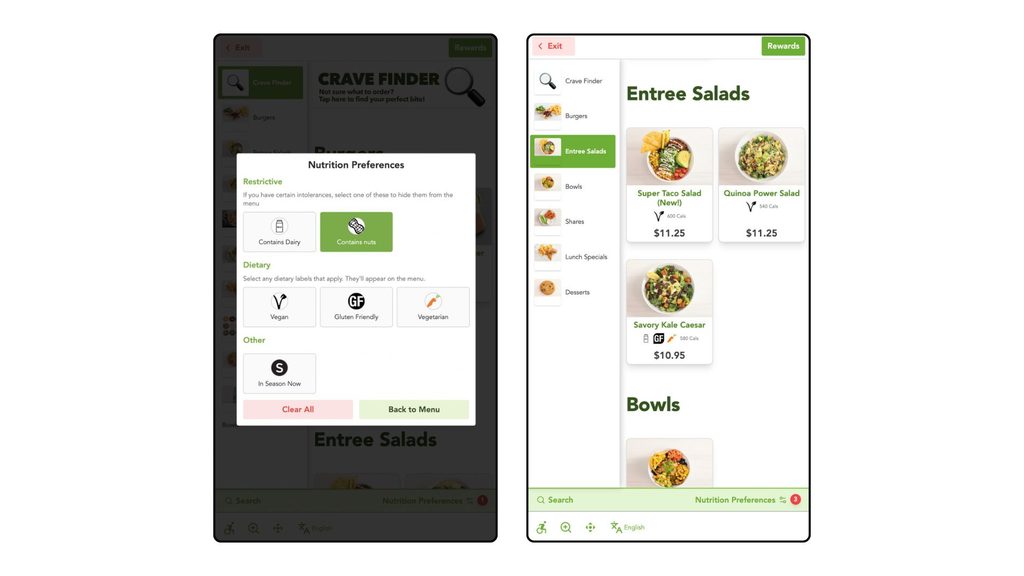
- There’s room to say more. A menu board is one fixed piece of wall, which is why allergen details always lose the fight against the photo of the burger. A kiosk has as many screens as it needs. Full allergen and nutrition information can sit one tap behind every item without shrinking anything else.
- Nobody has to disclose a medical condition to a stranger. This is the underrated one. A kiosk lets a guest filter privately, at their own pace, without narrating their health history over a counter to someone they’ll never see again.
- The filter catches the mistake before it happens. A guest can set their restrictions when they start the order, and unsafe items get flagged or hidden right there on screen. You prevent the wrong order instead of remaking it.
- One update, every store, same day. Change an ingredient once, and every kiosk in every market shows the change immediately. That matters when seven states are each writing their own disclosure rules. The alternative is reprinting menu inserts for 300+ locations.
And none of this slows the line.
What good looks like—and where operators get it wrong
The most common mistake is a PDF allergen chart behind a QR code. Technically compliant, however, useless in practice. It asks a guest to stop ordering, pinch-zoom a spreadsheet on their phone, cross-reference it themselves, and then come back.
The better fix is a filter that keeps working all the way through the order—modifiers, combos, add-ons, everything. A filter that handles entrées and then quietly gives up at the sauce is worse than no filter at all, because by then the guest trusts it.
Best is filtering that sells. Don’t just subtract the unsafe items; surface the item they can have, including the premium one. A guest who walked in expecting to settle for a side salad and instead finds a protein bowl they trust spends more, not less.
One warning: filtering is only as trustworthy as your ingredient data. If your recipe records are stale or inconsistent across suppliers, a filter doesn’t reduce your risk—it formalizes it. Fix the data before you ship the feature.
The guests you’re not losing
No version of this goes backward. Allergen disclosure is becoming law, GLP-1 use keeps climbing, and the generation that grew up filtering everything from flights to streaming libraries is not going to start asking a cashier.
The operators who win here won’t be the ones with the longest list of allergen-free items. They’ll be the ones who made those items effortless to find.
Every filter you add is a guest you stop losing at the door.